
.png?width=48&height=48&name=Group%201%20(3).png)
























What is an Articulation Disorder?
Learning to talk requires incredible precision. To make a single sound, your brain must tell your jaw, lips, teeth, tongue, and vocal cords exactly where to go and how to move.
An articulation disorder is a motor-based speech issue. It occurs when a person has physical difficulty placing their mouth parts in the correct position to make a specific sound past the expected developmental age.
Unlike a language delay (where someone struggles to find the right words) or a phonological disorder (where the brain mixes up the rules of sounds), an articulation issue is purely about the physical production of the sound itself.
Common Examples of Articulation Errors:
- Lisps: The most common articulation error. This includes an interdental lisp (the tongue pokes between the front teeth, turning an "s" or "z" into a "th" sound) or a lateral lisp (air escapes out the sides of the tongue, creating a slushy or "spitty" sound).
- Distortions: The sound is made, but it sounds "off" or muffled (often the case with the "r" or "l" sounds).
- Substitutions: Swapping a hard-to-say sound for an easier one (e.g., saying "wabbit" instead of "rabbit" or "fumb" instead of "thumb").
Who We Help at Our Canterbury Clinic
Articulation errors don't just affect kids. At daar, we provide tailored pronunciation support across the lifespan:
Paediatric Articulation Therapy
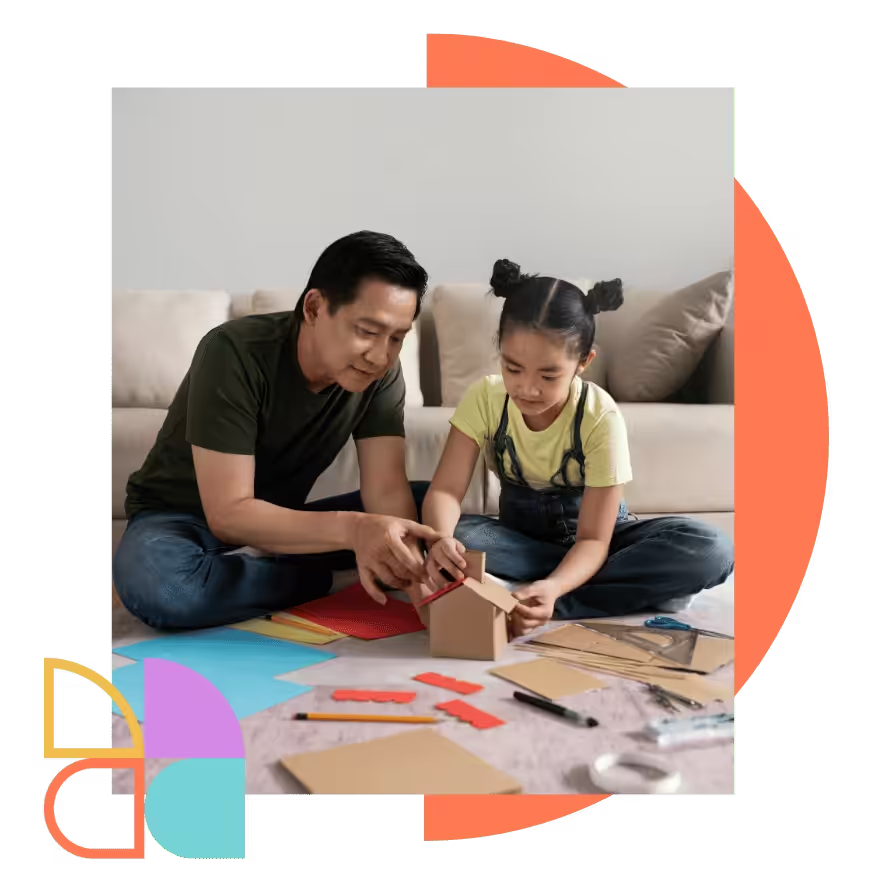
For children, untreated articulation disorders can lead to social withdrawal, teasing, and difficulties learning to read and spell. We work with toddlers, preschoolers, and primary-aged children to correct speech errors early. We use a highly engaging, play-based approach so your child builds their speech skills while having fun.
.png)
The daar Approach to Articulation Correction
Fixing an articulation error isn't as simple as telling someone to "try harder." It requires retraining deeply ingrained muscle memory. Here is how our Canterbury team handles the process:
- Comprehensive Assessment: We listen to spontaneous speech and conduct formal articulation tests to identify exactly which sounds are tricky and assess the physical movement of the mouth and jaw.
- Phonetic Placement: We teach you exactly where to put your lips, tongue, and teeth. We use visual feedback (like mirrors), tactile cues (like resting a dynamic tool on the tongue), and specific instructions to help you feel the correct position.
- High-Repetition Drilling: Once the sound is achieved in isolation, we drill it! We use specific exercises to practice the sound in syllables, then words, then sentences.
- Generalisation: This is the most crucial step—taking the sound out of the clinic and into the real world. We practice using the new sound in spontaneous conversation.
- A Custom Home Practice Plan: Changing muscle memory takes daily practice. We provide parents and adult clients with short, effective daily exercises (often taking just 5-10 minutes) to lock in progress between sessions.
.png)
NDIS, Medicare, and Easy Funding Pathways
We help Canterbury locals access top-tier therapy through a range of Australian funding pathways:
- NDIS: We support Self-Managed and Plan-Managed NDIS participants, providing both assessment reports and ongoing articulation therapy.
- Medicare: Have a chat with your GP. If you have a Chronic Disease Management (CDM) plan, you can access Medicare rebates for up to five speech pathology sessions per year.
- Private Health: If your 'Extras' cover includes Speech Pathology, we offer on-the-spot claiming via HICAPS at our Canterbury clinic.
.png)
Frequently Asked Questions:
My 3-year-old says "wabbit" instead of "rabbit". Does he need therapy?
Not necessarily. The Australian speech developmental milestones show that the "r" sound is one of the hardest sounds to master. It is completely typical for a 3-year-old to substitute "w" for "r". Most children will naturally acquire the "r" sound by the time they are 5 or 6. However, if your child is approaching school age and the error persists, an assessment at daar is recommended.
What is a "lateral" lisp, and does it go away on its own?
An interdental lisp (where the tongue comes out the front) is a normal part of early development and some kids outgrow it. A lateral lisp (where air shoots out the sides of the mouth) is never a part of typical speech development. It sounds slushy or wet. A lateral lisp rarely corrects itself without professional intervention, so we recommend booking an assessment with our Canterbury clinic as soon as you notice it.
How much home practice is required?
To permanently fix an articulation disorder, short but frequent practice is the secret. We typically ask clients (or parents) to commit to practicing for just 5 to 10 minutes, once or twice a day. This frequent repetition helps the brain and mouth form new, permanent motor habits much faster than one long practice session a week.
.svg)


Find Us Here

Shop 1 364 Canterbury Rd Canterbury NSW 2193
Underground parking is available behind our building on Onslow St. Take the elevators up to Ground Floor to access our clinic.
.svg)

Get access to quality, Efficient, and professional care.
Request a call to find out how daar can help you achieve your health goals.

Leading source of information for allied health news, studies and resources.

We support you to be self-determined and independent, giving you the control and freedom to achieve your individual goals

We provide superior quality, client-centric and innovative treatment to support you to realise your full potential





.svg)